
Missouri Financial Literacy Statistics
The Missouri Financial Educators Council (MFEC) gathers and analyzes data to measure financial wellness throughout the Show-Me State. These insights are consistently updated and made available here to support informed decision-making. The information empowers policymakers, community leaders, and advocates to promote effective financial literacy education and implement related policy when it is enacted. Ensuring continued progress in financial wellness is central to the Missouri Council’s mission, and providing the information here supports that objective.
Cost of Financial Illiteracy Survey
Missourians report that lack of financial knowledge carries a high cost, according to the NFEC’s most recent survey. Participants across the state responded to the single question: “During the past year, about how much money do you think you lost because you lacked knowledge about personal finances?” The results are shown below. Since 2017, the NFEC has conducted this annual survey, consistently revealing that the average individual cost of financial illiteracy approaches or exceeds $1,000 per person – with estimated national losses reaching into the hundreds of billions of dollars each year, and losses in the hundreds of millions across Missouri.
Cost of Financial Illiteracy
$0 – $499
$500 – $999
$1,000 – $2,499
$2,500 – $9,999
$10,000 +
Financial Vulnerability in Missouri
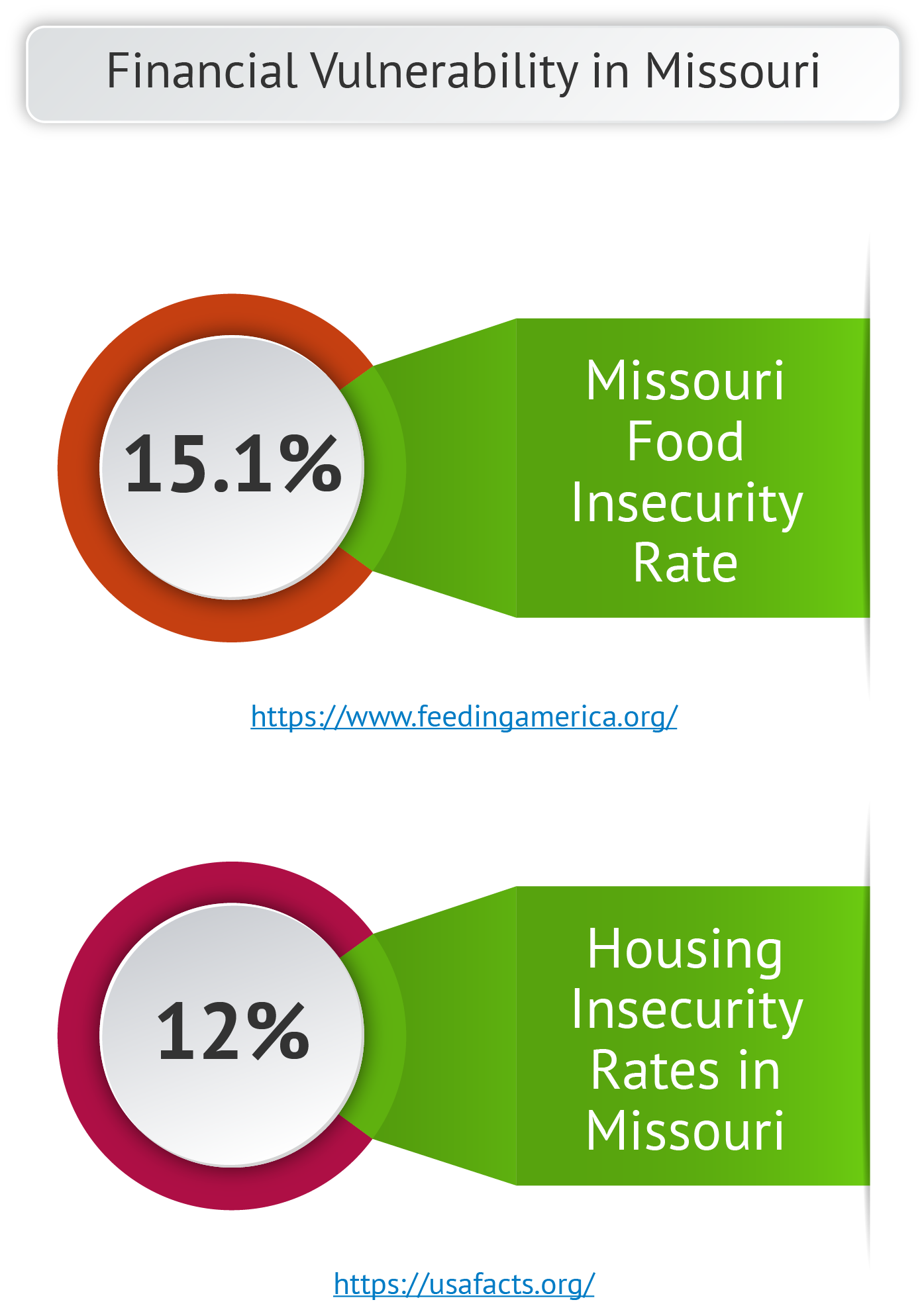
Housing insecurity and food insecurity represent the two most important metrics that characterize Americans’ financial vulnerability. Nonprofit organization Feeding America indicates that hunger among Missourians is a significant problem, with close to a million people (951,330; 15.1%) facing food insecurity in the state – one out of every six individuals. Of those people, 248,620 are children. A total 44.8% of Missouri households receiving SNAP (formerly food stamps) benefits have children in the home.
Housing insecurity paints a similar picture, with the World Population Review (WPR) reporting that 7,312 individuals were unhoused in Missouri in 2024 – a homeless rate of 12%, and a figure that has increased by 17% since 2007. WPR’s definition of homelessness is “living in a temporary shelter or transitional housing or sleeping in a place not meant for habitation (like an abandoned building).”
Data on Missourians’ Financial Situations
Average Total Consumer Debt
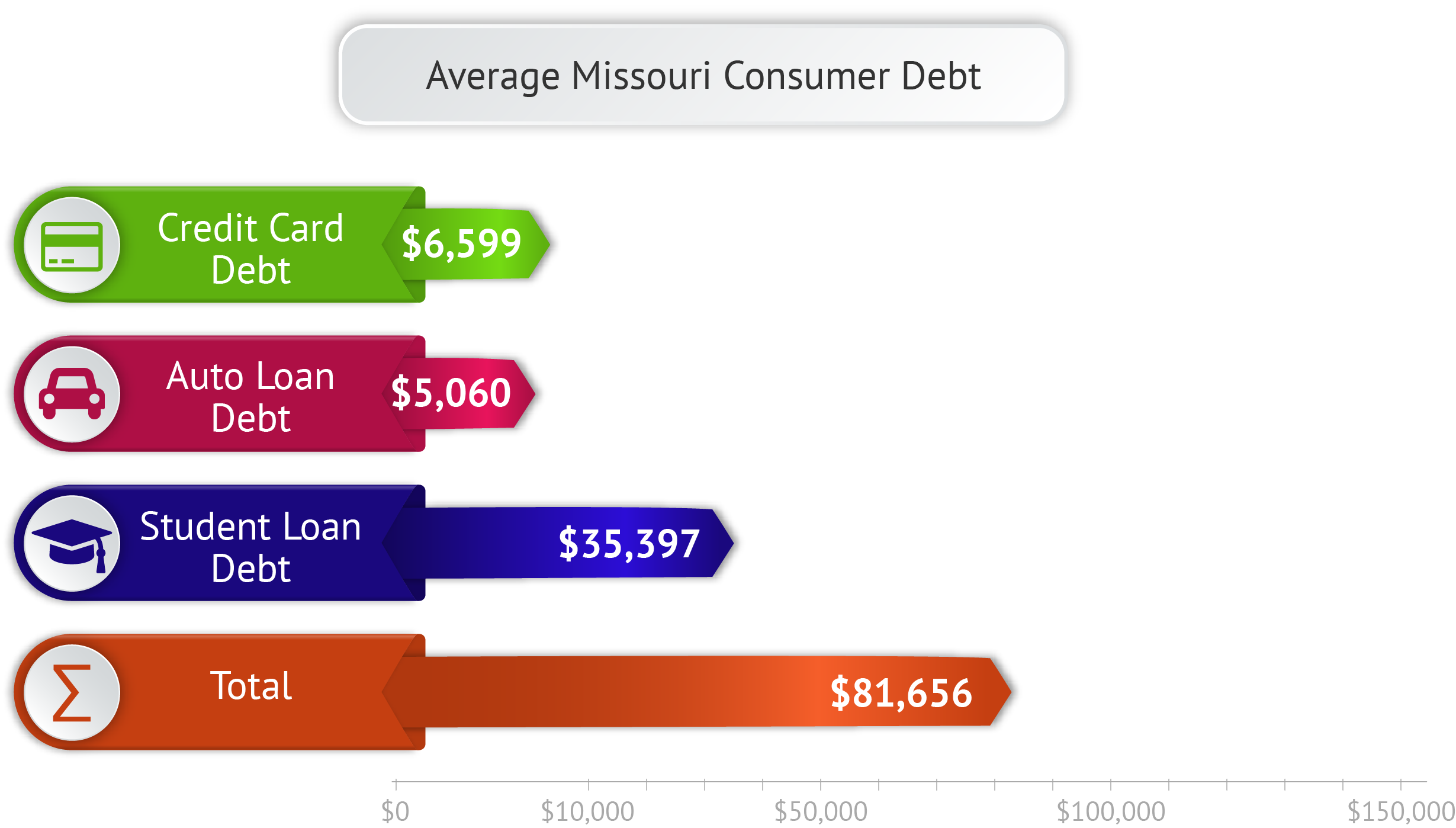
Total consumer debt among Americans is at an all-time high – above $18 trillion as of the end of 2025. These data underscore the significant need for financial wellness education in the U.S. For Missouri, Experian data place the average total debt per consumer in the Show-Me State at $81,656 in 2025. That estimate showed a modest decrease of -0.6% from 2024, and sat below the national average of $104,755.
Specific Debt Categories
Breaking down Missouri debt into categories, we learned that those Missourians who carried student debt had an average balance of $35,397 in 2026 according to the World Population Review. A WalletHub study found that the average amount a credit card user in Missouri held in credit card debt was $6,599 in 2025. And further data from the World Population Review show that the average auto loan debt in Missouri was $5,060 in 2024; that figure is likely to have increased year over year since then.
Missouri Financial Literacy Education and Legislation Statistics
The National Education Association (NEA) publishes regular data on number of school districts, students enrolled, and teaching staff in each U.S. state by academic year. In September 2025, the NEA’s most recent report ranked Missouri 11th in the country for number of public school districts, with 556 in the 2023-2024 school year. The state had total enrollment of 859,885 that year; and employed 70,945 teachers. These figures translate to an estimated 12.1:1 student-to-teacher ratio.
Regarding school financial literacy legislation, Missouri does require each student to complete a one-half-credit standalone personal finance course for high school graduation. This mandate was enacted in 2005 as House Concurrent Resolution No. 24, which resolved “that the Missouri State Board of Education be encouraged to accept the recommendation as prepared by the Missouri Commissioner of Education and the Missouri Taskforce on the High School for coursework in personal finance economics” which calls “for a required course in personal finance economics for graduation.” This proposed requirement was approved along with the new recommended high school graduation requirements at the October 2005 Missouri State Board of Education Meeting.